
Jump to a section
- What does a new gutter system include?
- What size gutters does a house in Oregon City need?
- Which material should I choose?
- How is a seamless gutter installed?
- Installation terms
- How much does gutter installation cost?
- What about slopes and drainage?
- When is the best time to install?
- A short checklist before the measuring visit
What does a new gutter system include?
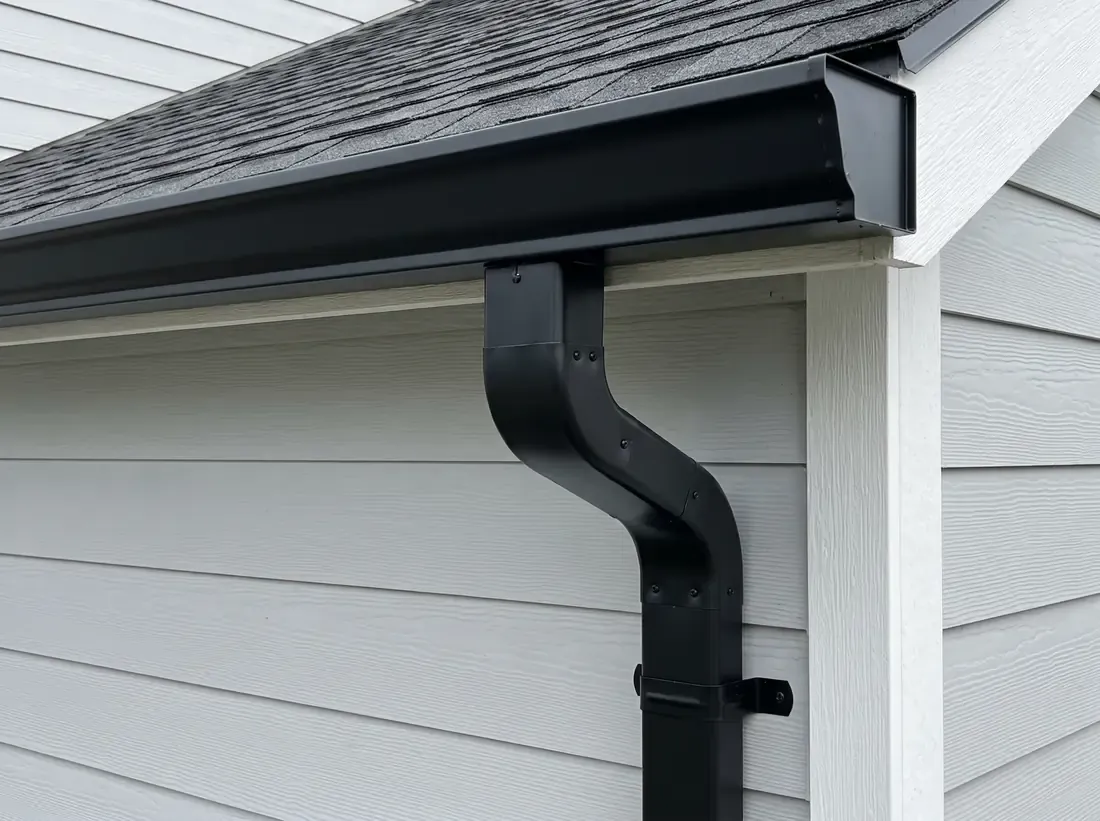
A full installation covers more than the trough. Expect edge flashing where it is missing, gutter runs formed to length, corners, end caps, outlets, hangers, leaders with their elbows and straps, and a plan for where each leader empties. Guards are an option on top.
| Part | What it does | Common choice around Oregon City |
|---|---|---|
| Gutter | Catches roof water along the eave | 5 or 6-inch K-style seamless aluminum |
| Hangers | Hold the gutter to the fascia | Screwed hidden hangers about every 24 inches |
| Outlets | Let water into the leaders | Roughly every 30 to 40 feet, and beside each valley |
| Leaders | Carry water to the ground | 2x3 on small roofs, 3x4 under trees |
| Discharge | Where water ends up | Extensions, rain drains or piped outlets on slopes |
| Guards | Keep debris out | Stainless micro-mesh under firs |
What size gutters does a house in Oregon City need?
Most single-level ranches in Gladstone, Milwaukie or South End drain well with 5-inch K-style and enough outlets. Two-level homes in Hillendale, Happy Valley, West Linn and Lake Oswego usually need 6-inch with 3x4 leaders, especially below valleys and under trees. Older homes on the McLoughlin bluff and in Canemah often suit half-round. See 6-inch gutters and the sizing guide.
Which material should I choose?
| Material | Strengths | Trade-offs | Where it fits |
|---|---|---|---|
| Aluminum, .032 inch | Rust-free, light, many colors | Dents under heavy impact | Most homes |
| Aluminum, .027 inch | Lower cost | Bends more easily under ladders and ice | Sheltered single-level eaves |
| Galvanized or Galvalume steel | Strong, resists dents | Rusts where coating fails | Shops, barns, commercial |
| Copper, 16 or 20 ounce | Very long life, ages to brown | High cost, runoff can stain | Historic and showpiece homes |
| Vinyl | Cheap, DIY-friendly | Brittle with age and cold | Small outbuildings |
Read more on seamless gutters, copper, half-round and downspouts, or compare metals in the materials guide.
How is a seamless gutter installed?
- Measure every eave, note corners, valleys and roof heights, and agree where each leader will go.
- Check the fascia and rafter tails; replace soft boards before anything is hung.
- Fit drip edge or gutter apron where the roof edge has none.
- Form each run on the seamless machine to the exact length of the eave.
- Cut outlets, fit end caps and corners, and seal every joint.
- Hang the run on screwed hidden hangers, set to a slight fall toward each outlet.
- Attach leaders with elbows and straps, and connect them to extensions, drains or piped outlets.
- Run water through every section and outlet to confirm flow before cleanup.
Installation terms
| Term | In plain words |
|---|---|
| Drip edge | An L-shaped metal strip along the roof edge that kicks runoff forward so it drops into the trough instead of soaking the board behind |
| Gutter apron | A longer flashing slid under the first shingle course, with a tail that hangs inside the gutter so water cannot slip behind it |
| Hidden hanger | A concealed clip spanning the trough below its lip, held by a screw driven back through the gutter into the board |
| Outlet | The short tube set through the gutter floor that hands water down to the leader; also called a drop |
| Elbow | A bent section of leader: A-style angles in or out from the siding, B-style angles left or right |
| Fall | The slight tilt of a gutter toward its outlet, typically a quarter inch for every ten feet |
| Coil | The roll of painted sheet metal fed through a seamless gutter machine |
| Valley diverter | A short metal baffle under a valley that knocks down the surge before it jumps the lip |
How much does gutter installation cost?
National price guides from Angi and This Old House put fitted seamless aluminum at about $9 to $13 a foot for 5-inch and $12 to $18 for 6-inch, with copper at $25 to $40 a foot. A typical single-level home needs 120 to 170 feet; two-level homes often 180 to 260. Height, slope, corners, trim repairs, leaders and guards all change the figure. The cost guide goes into detail.
Ballpark the price for your home
$1,440 to $2,240
Worked out from national per-foot ranges published by Angi on aluminum gutter costs, This Old House on seamless gutter costs. Corners, leaders, trim repair, slope and access all move the number; only a measured quote from the contractor is a real price.
What about slopes and drainage?
A gutter is only half the job; where the water ends up matters as much. On flat lots, extensions carrying water several feet out are usually enough. On older lots, buried rain drains may be reused if they still flow. On slopes, the City of Oregon City warns that concentrating downspout water onto a slope can trigger landslides, so leaders should be piped to a safe outlet. See downspouts on hillside lots.
When is the best time to install?
The dry months from June to September give the easiest scheduling and working conditions. Fall is the busiest period, as overflowing gutters get noticed in the first heavy rain. Installing before October means the new system is ready for the wettest months.
A short checklist before the measuring visit
- Clear a path along each wall: bins, planters, firewood, the barbecue.
- Tell the caller about gates, dogs, a steep drive or a soft lawn the ladders will sit on.
- Stand outside in the next downpour and note any stretch that pours over.
- Trace each leader to its end: lawn, splash pad, pipe in the ground or the street.
- Decide whether to see guards priced as a separate line.