
Jump to a section
- What size downspouts do I need?
- How many leaders should a house have?
- Where should downspouts empty?
- How are downspouts installed?
- Downspout terms
- Disconnection and rain gardens
- Downspouts and elbows: A-style and B-style
- Placing drops before the gutter is made
- Leader screens and strainers
- Straps and wind
- Discharge on flat ground
- Leaders and gutter guards
- Color matching
- More quick answers
What size downspouts do I need?
| Leader | Use | Notes |
|---|---|---|
| 2x3 rectangular | Small roofs, open sky | Clogs more easily under trees |
| 3x4 rectangular | Most homes under trees, 6-inch gutters | Passes needles and small cones |
| 3-inch round | Half-round on smaller roofs | Traditional look |
| 4-inch round | Half-round on bigger roofs | More capacity |
How many leaders should a house have?
A rule of thumb is a drop for every 30 to 40 feet of eave and another right beside any valley. Long runs that empty at only one end carry all their water past every hanger, and spill in heavy rain.
Where should downspouts empty?
| Lot | Outlet | Watch for |
|---|---|---|
| Flat yard | Extension or splash block several feet out | Ground sloping back to the wall |
| Older lot with a rain drain | The drain, if it flows when tested | Roots, silt, cracked pipe |
| Lawn with room | Rain garden | Distance from foundations and septic |
| Acreage | Dispersion area | Septic fields and wells |
| Sloping lot | Sealed pipe to a safe outlet | Never onto the slope |
The City of Oregon City notes that downspout water concentrated onto slopes can help trigger landslides. On a hillside, ask exactly where each leader will end. See downspouts on hillside lots.
How are downspouts installed?
- Plan drop positions before gutters are formed.
- Cut outlets and seal the drop tubes.
- Fit elbows to bring the leader to the wall.
- Fix straps at regular intervals, into framing where possible.
- Fit the bottom elbow and connect to an extension, drain or pipe.
- Test with water from the gutter.
Downspout terms
| Term | In plain words |
|---|---|
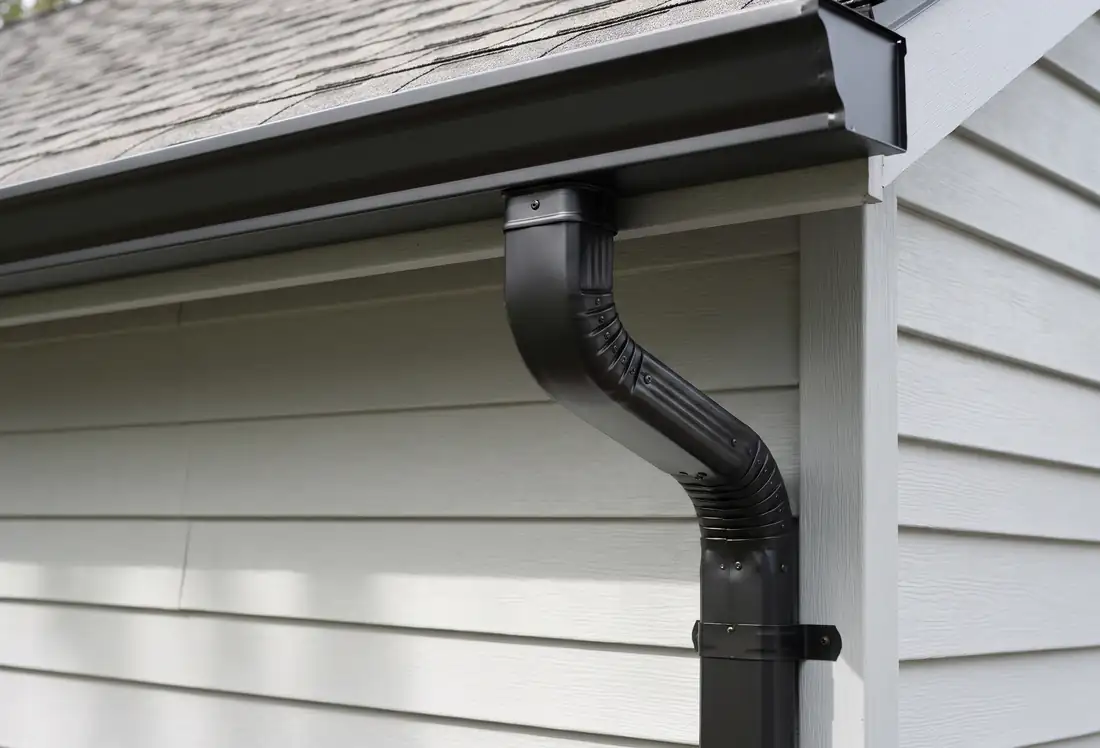
| Downspout | The pipe that runs down the wall from gutter to ground; also known as a leader |
| Elbow | A bent section of leader: A-style angles in or out from the siding, B-style angles left or right |
| Strap | A formed band screwed to the wall that clamps the leader in place |
| Extension | A length of pipe or a flip-down section that carries water out away from the foundation |
| Splash block | A ribbed pad under the leader outlet that fans the water out and protects the soil |
| Cleanout | A capped fitting at the base of a leader where it enters a buried line, so the pipe can be rodded |
| Rain drain | The buried pipe a leader drops into, common on older Clackamas County lots and often tied to a curb outlet or drywell |
| Drywell | An underground perforated chamber or rock pit that lets roof water seep into the soil |
Disconnection and rain gardens
Clackamas County Water Environment Services encourages letting stormwater soak in on site, for example with rain gardens. See rain gardens and downspout disconnection.
Downspouts and elbows: A-style and B-style
| Elbow | Turns | Use |
|---|---|---|
| A-style | Toward or away from the wall | Bringing a leader from the outlet back to the siding |
| B-style | Sideways along the wall | Moving a leader around a window or corner |
| Wide-mouth elbow | As A or B, with a larger opening | Under trees, to reduce clogs |
Placing drops before the gutter is made
The best moment to decide drop positions is before the gutter is formed. Go round the house with the installer and settle each one: beside valleys, at the ends of long eaves, and wherever the water has a safe path away. Moving a drop later means cutting a new hole and patching the old one.
Leader screens and strainers
A screen at the outlet, or a strainer where a leader enters a buried drain, catches needles and seeds before they lodge in an elbow or pipe. They need emptying occasionally but save a lot of clearing.
Straps and wind
On tall walls, leaders need straps at regular intervals, screwed into framing where possible. A loose leader swinging in wind cracks its elbows and can pull off the outlet. After ice storms, check straps along exposed walls.
Discharge on flat ground
On flat lots in Gladstone, Canby and parts of Milwaukie, water from an extension can sit where it lands. Make sure the ground slopes away, or carry water further with a longer extension or a pipe to a lower spot.
Leaders and gutter guards
Guards keep most debris out, but leaders still collect grit. Check them yearly.
Mark each planned drop on a sketch of the house.
Color matching
Leaders usually match the gutters, though on some homes they are painted to match the siding so they disappear.
More quick answers
Do downspouts need screens? Under trees, outlet screens reduce clogs.