
Jump to a section
- What are the main types of gutter guard?
- How do I choose?
- Guard terms
- Reverse-curve hoods and appearance
- When a cheap screen is enough
- Switching guard types
- Cost comparison
- Do-it-yourself guards
- Guards and older gutters
- Matching guard to tree
- Questions to ask before buying guards
- Guards and gutter size
- The bottom line
- Guard installation and licensing
- Guards for half-round
- More quick answers
What are the main types of gutter guard?
| Guard | Principle | With firs above | With maples or oaks above |
|---|---|---|---|
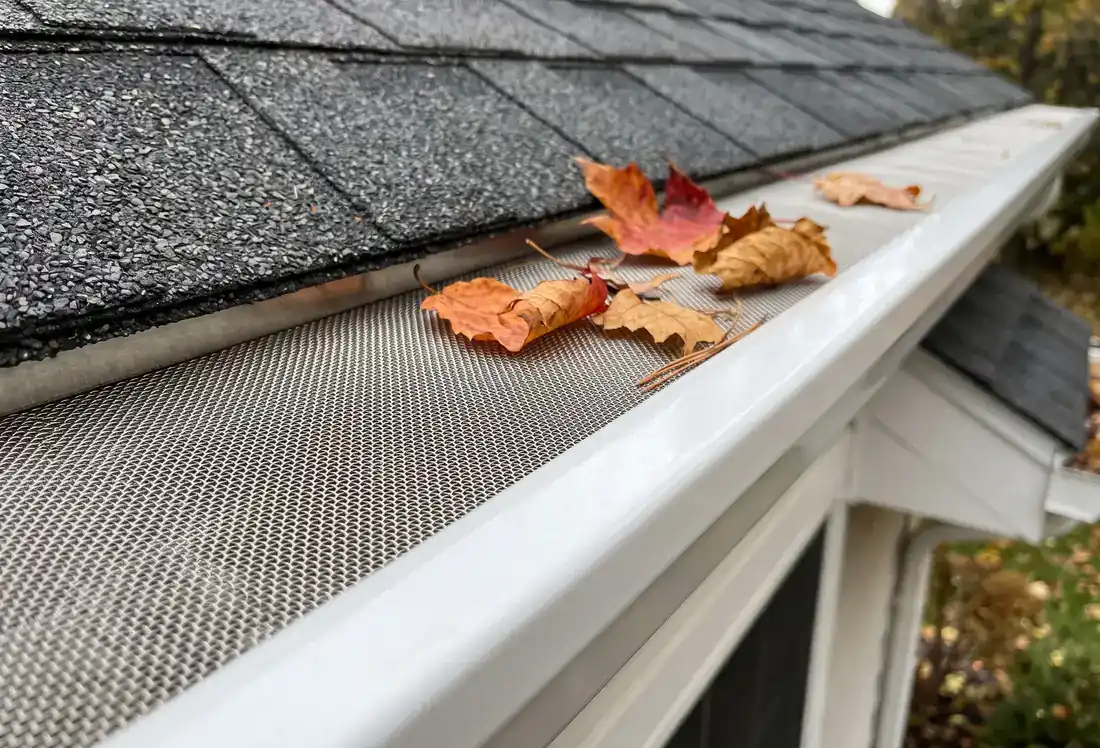
| Micro-mesh | Fine stainless weave on a frame | Best | Good |
| Perforated cover | Punched sheet | Mostly on top; a few drop through | Works |
| Screen | Coarse grid | Needles lodge in the grid | Fair |
| Reverse-curve hood | Water wraps a curved nose into a slot | Needles gather at the nose | Good |
| Foam insert | Spongy block filling the trough | Holds needles, sprouts moss | Leaves pile on it |
| Brush insert | Bristle tube in the trough | Needles knot in the bristles | Leaves snag on top |
How do I choose?
- Look at what trees overhang the roof.
- Consider how high and hard to reach the gutters are.
- Check the gutters are sound; fix them first.
- Compare prices per foot on the same footage.
- Ask how each guard attaches and comes off for cleaning.
Guard terms
| Term | In plain words |
|---|---|
| Micro-mesh | A fine stainless-steel weave on a stiff frame that lets water through and keeps needles out |
| Perforated cover | A guard made from metal or plastic sheet full of small holes |
| Reverse curve | A solid hood guard; water clings round its curved nose and drops into a slot below |
| Moss | Shade-loving growth on damp roofs that breaks off in clumps and settles in troughs |
| Gutter apron | A longer flashing slid under the first shingle course, with a tail that hangs inside the gutter so water cannot slip behind it |
| Outlet | The short tube set through the gutter floor that hands water down to the leader; also called a drop |
Reverse-curve hoods and appearance
Hoods cover the whole gutter with a rounded front, which changes the look of the eave. Some homes suit it; others look bulky. Ask to see photos on a similar house.
When a cheap screen is enough
On a shed, garage or open single-level eave with occasional leaves, a simple screen may do. Under tall firs, or where cleaning is costly, mesh usually pays back its price.
Switching guard types
Old screens or inserts are removed and the gutters cleaned before new guards go on. Ask whether removal is in the quote.
Cost comparison
| Guard | Relative cost | Typical life |
|---|---|---|
| Plastic screen | Lowest | Short; can warp |
| Foam insert | Low | Short; breaks down |
| Brush insert | Low | Moderate |
| Perforated aluminum | Middle | Long |
| Reverse-curve hood | Higher | Long |
| Stainless micro-mesh | Higher | Long |
Do-it-yourself guards
Screens and inserts from home stores are easy to fit on a single-level eave. On two-level homes and slopes, the ladder work is the same as cleaning, so most owners hire the work. Professional mesh installation is licensed work in Oregon.
Guards and older gutters
Guards rest on the gutter, so the gutter must be sound, firmly fixed and properly pitched. Fitting guards to a sagging or leaking system hides the problem. Fix or replace first.
Matching guard to tree
Under firs and cedars, choose fine mesh. Under maples and oaks, perforated covers or hoods work too. On open lots, a guard may not be needed at all.
Questions to ask before buying guards
- What is the guard made of, and how long is it expected to last?
- How does it attach: under shingles, to the gutter lip or to the fascia?
- Can panels be lifted off for cleaning or inspection?
- Is gutter cleaning included before fitting?
- What happens if a panel lifts in a storm?
Guards and gutter size
Guards cover the top of the gutter and slightly reduce the opening water enters through. On large roofs, make sure gutters and leaders are big enough before adding guards.
The bottom line
Under Douglas firs, choose fine stainless mesh. Under maples and oaks, mesh, perforated covers and hoods all work. On open lots, guards may not be needed. Whatever you choose, make sure the gutters underneath are sound and sized for the roof first.
Guard installation and licensing
In Oregon, installing guards is gutter work and needs a CCB license. Check the number before agreeing.
Guards for half-round
Half-round gutters need guards shaped to their curve; ask whether a guard is made for your profile.
More quick answers
Do guards reduce how much water gets in? Slightly; make sure gutters are sized well first.
Which guard lasts longest? Stainless micro-mesh and solid aluminum hoods generally outlast screens and inserts.
Are hoods good under firs? Needles tend to collect along the curve, so mesh is usually better.